
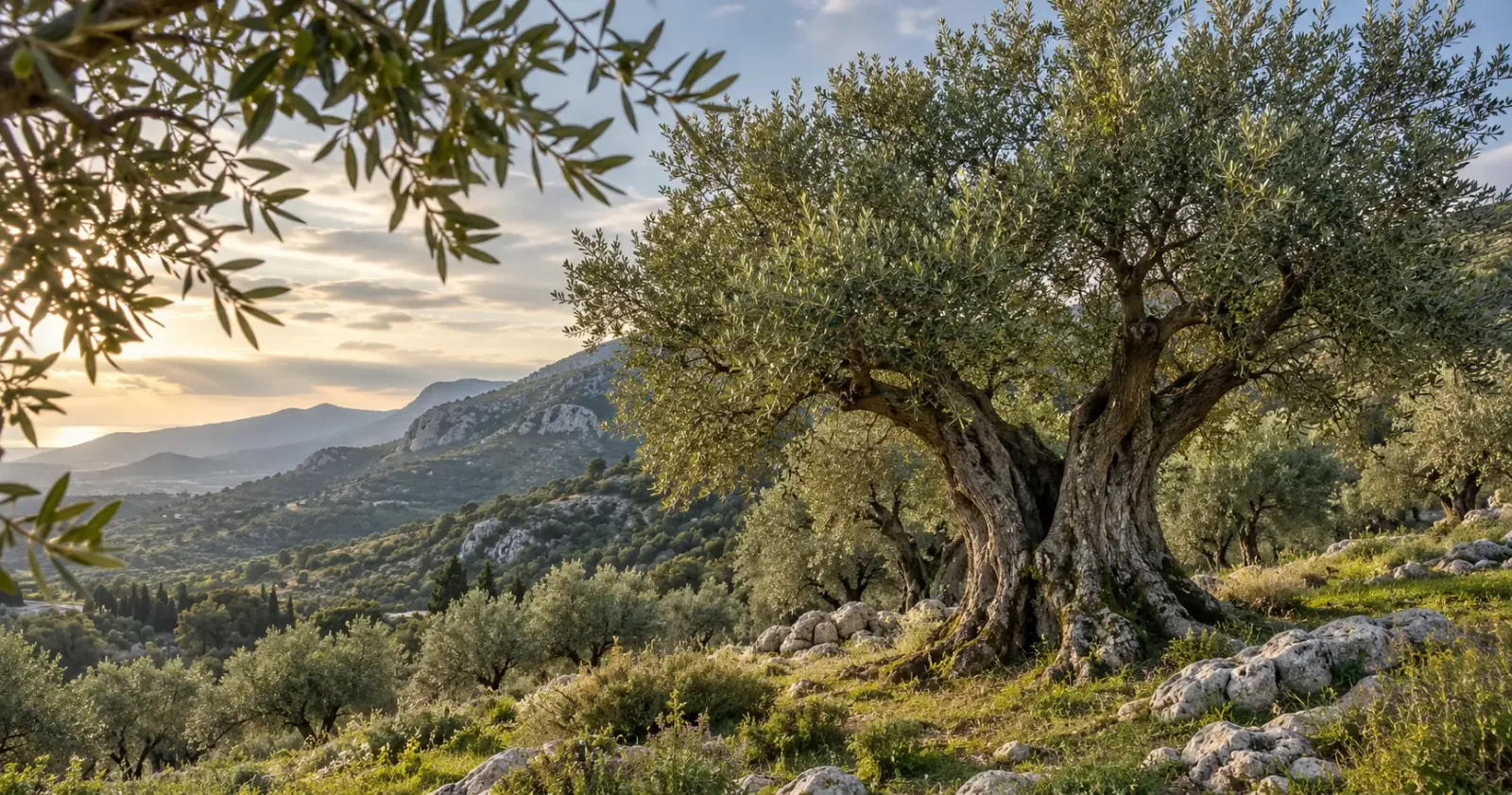
The historian Vincenzo Cuoco identified a Samnite figure named Licinius as the man who brought olive growing to the Venafro area. During an imaginary philosophical and archaeological journey through southern Italy, he has Cleobulus write to Plato: “You Greeks believe that the olive does not thrive forty miles from the sea; some time ago we believed it too, and the inhabitants of the Mainarde and the Maiella were forced to buy their oil from the people of the lands near the sea.
My friend Licinius wished to introduce the olive into his homeland. He was a citizen of Venafro. After long research, among the many species of this plant, he finally found one able to withstand the cold of his native mountains; and the oil of this olive is in no way inferior to the oil of the Salentines and the Tarentines.”
 In the 2nd century BC, Marcus Porcius Cato, who owned a country villa with olive groves at Venafro, recommended in De Agri Cultura, CXLVI, applying the method used at Venafro for selling fruit still on the tree (“Oleam pendentem hac lege venire oportet. Olea pendens in fundo Venafri venibit…”). It lays down precise rules for the sale of olives and their purchase price. From it we learn that green oil, Roman oil and windfall olives were produced at Venafro.
Horace described Venafro as cloaked in olive trees (“Ille terrarum mihi praeter omnes, angulus ridet ubi non Hymetto mella decedunt, viridique certat Bacca Venafro” – That corner of the world smiles on me more than any other, where the honey yields nothing to that of Hymettus and the olive vies with the green berry of Venafro – Odes and Epodes, II, 6, ll. 13–16).
According to Presta, the adjective “green” is used by Horace to refer to the qualities of the oil: the oleum viride, or semi-omphacine oil, produced at Taranto and Venafro. On this point Columella, in De Re Rustica, urges oil producers to order the harvesting of the Licinia and Sergia olives when the drupes begin to change colour, having judged this to be the best moment to pick them for making oleum viride.
It is widely held that the Venafro area was one of the first regions to cultivate the tree that the Athenians considered sacred, introduced from Campania as far as Latium in remote times, although, according to Pliny, the olive was absent from Italy before 581 BC.
Olive growing reached such intensive and extensive levels that Venafro became famous throughout the Roman world.
Quod far comparem campano, quod triticum appulo, quod oleum venafrano? (What spelt could I compare with that of Campania, what wheat with that of Apulia, what oil with that of Venafro?) proclaimed Marcus Terentius Varro (De Re Rustica, book 3, 1, 2), and Marcus Valerius Martial wrote: “Hoc tibi sudabit bacca Venafri…” (This oil was distilled for you by the olive of Campanian Venafro – Epigrammaton, XIII, 101), praising the qualities of Venafro oil in the preparation of ointments: unguentum quoties sumis et istud olet”; “Uncto Corduba laetior Venafro / Histra nec minus absoluta testa” XII, 63, ll. 1–2
Horace again, in one of his satires, considered a sauce of aromatic herbs and saffron to be astonishing only if dressed with Venafro oil.
In another satire, he extolled the flavour of a moray eel bathed in a sauce made with Venafro oil from the first pressing. (“His mixtum ius est: oleo, quod prima Venafri pressit cella…” the sauce is made of these ingredients: oil pressed by the first oil mill of Venafro… / “Pressa venafranae quod bacca remissit olivae…” oil that the press of Venafro released from the olive berry – drupe, 1.2 – sat. 4/1.2 sat. 8).
Pliny the Elder stated: “Principatum in hoc quoque bono obtinuit orbe maxime agro venafrano, eiusque parte, quae Licinianum fudit oleum unde et Liciniae gloria praecipua olivae” (For this product too, oil, Italy holds first place over the whole world, above all in the territory of Venafro, and in that district which produces Licinian oil, from which the Licinian olive has above all gained such renown).
“Unquenta hanc palmam dedere accomodato ipsis odore. Dedit et palatum delicatiorem sententiam. Coetero baccas Liciniae nulla avis appetit” (Pliny, De Oleo, vol. II, XV, 1, 8, p. 513).
 In his satire on Virro, Juvenal recounted: “Ipse venafrano piscem perfudit: at hic, qui | pallidus adfertur misero tibi caulis, plebi | lanternam…” (Virro poured Venafro oil over his fish, while his guests were given lamp oil, used for lanterns – Satires, I, 5, l. 85).
Heurgon rightly maintains, according to Gennaro Morra, that Virgil cannot have failed to think of Venafro when mentioning the olive (“illa tibi laetis intexet vitibus ulmos | illa ferax oleo est, illam experiere colendo | et facilem pecori et patientem vomeris unci: | talem dives erat Capua.” Georgics, II, ll. 221–225), which was rare in Campanian territory: “It is rather there, in fact, between 200 and 600 metres above sea level, on the slopes of the hills descending towards the upper and middle Volturno, that we should look for Virgil’s olives.”
The olive groves and oil of Venafro were so highly prized throughout the Mediterranean basin that the geographer Strabo, in the 1st century BC, mentions them in his description of Italy (Geographica, V, 3, 10).
Giovanni Presta of Gallipoli, the foremost scholar of olive growing at Venafro, in the preface to his “Memoir on the 62 different samples of oil presented to His Majesty Ferdinand IV, King of the Two Sicilies” (1788), speaking of the finest oil in Roman times, wrote: “In this Venafro  stood out, and the little oil that was obtained there was mostly reserved for the owners of the olive groves; it was reserved for the most refined, the most fastidious, the richest”. “…and yet it will not be found that our oils are surpassed by those of Venafro, and in particular by those of the Licinia, which was the olive whose oil the ancients knew of none better”.
Venafro and its olive trees aroused the admiration of travellers of the past, such as the Dominican abbot Serafino Razzi towards the end of the 16th century, and the abbot Giovan Battista Pacichelli in 1685. In 1789 the Swiss count Carlo Ulisse De Salis Marschlins visited Venafro during a tour of the Bourbon Kingdom, together with scholars “of rural matters” and Archbishop D. G. Capecelatro.
In September 1790 Sir Richard Colt Hoare visited Venafro, having set out from Caserta in the company of “Don Andrea Paruta and Messrs Philip and George Hackert”. On 23 May 1793 G. M. Galanti, having set out from Capua, was in Venafro.
Venafro’s main agricultural product was also praised by Lorenzo Giustiniani in 1805, while Michele Tenore, the distinguished Neapolitan botanist, was in Venafro in the summer of 1831; in 1837 Richard Keppel Craven published the book “Excursions in the Abruzzi and Northern Provinces of Naples”, mentioning Venafro.
Covering more than 3,000 kilometres on foot, Craufurd Tait Ramage visited almost the entire Kingdom of Naples in 1868, stopping to admire the famous olive trees of Venafro. Jean Claude Richard de Saint-Non mentions Venafro, “famous for its oil, the best in all Italy”, in his description of the Kingdom of Naples and Sicily. To the German E. Paulus W. Kaden in 1885, on the other hand, the town of Venafro appeared poor compared with its past.
Others who wrote about Venafro and its olive trees include Alfonso Perrella, Berengario Amorosa, Giovanni Sannicola, secretary of the “Royal Economic Society of Terra di Lavoro”, and Frédéric Jacques Temple, who in 1943–44 took part in the Italian campaign with the French Expeditionary Corps and dedicated a moving poem to the olive trees.
Among experts on the subject, the olive trees of Venafro are mentioned by the Florentine Piero Vettori in 1594, in his “Treatise on the praises and cultivation of olive trees”; by Cosimo Moschettini of Martano (Lecce), drawing on Giovanni Presta’s research into the Licinia and Rosciola varieties; by Cavaliere Luigi Granata in 1841, in his agricultural catechism; and by the Marquis Giuseppe Palmieri of Martignano (Lecce), Minister of the Kingdom’s Supreme Council of Finance in 1789.
The Marquis of Pietracatella, Councillor and Minister of State to the King, President of the Council of Ministers of Ferdinand IV and President of the Royal Academy of Sciences of Naples, mentioned the magnificence of the Venafro olive trees in 1818.
In 1820 Father Niccola Onorati Columella, professor at the Royal University of Naples and a supporter of agriculture as the sole source of public happiness, named Licinian oil among the most important products of the Kingdom. In 1760 the great botanist Vincenzo Petagna, in his plant classification treatise “Institutiones Botanicae”, described the “Ulivo Gaetano” at Venafro.
“The tree is evergreen and always in flower. The inflorescence is in clusters, and in the clusters one can see fruits of various ages coming from different flowering times; they are food for thrushes.”
The Gaetano olive, the “male olive” of Venafro and the colonisation of Provence by Licinian olives are other subjects, at once technical and historical, that have prompted extensive academic debate over the centuries. These subjects have only recently been finally clarified in their essence, in the book by Prof.
Ferdinando Alterio “La storia dell’olivo. Il cammino di una grande pianta. Venafro cuore del mediterraneo olivicolo” (The history of the olive. The journey of a great plant. Venafro, heart of Mediterranean olive growing), published by Volturnia Edizioni (2011) on behalf of the Regional Olive Park of Venafro Park Authority.
The distinguished Venafro physician Niccola Pilla, who in 1811 was appointed by the French as editor-statistician for the survey “The Statistics of the Kingdom of Naples” commissioned by King Joachim Murat, was the first to classify the local Venafro varieties.
The considerable extent of the area under olives was preserved until the end of the last century, as emerges from the meticulous Physical, Economic and Moral Monograph of Venafro of 1877, written by the Primicerius Francesco Lucenteforte: “At the foot of the mountain that rises to the north-west of the valley lies Venafro, which overlooks the plain below.
A stranger arriving there for the first time cannot fail to be struck by the fine panorama that meets his gaze. He sees two forests of sturdy olive trees, flourishing luxuriantly to the right and left of the town along the slopes of the mountain from the village of Ceppagna to Pozzilli, over an area of more than nine kilometres by two; he observes well-ordered vegetable gardens and abundant waters which, after driving several mills, descend to form the charming river of S.
Bartolomeo.”
“The graceful and fruitful olive tree grows in the soil of Venafro so luxuriant and proud that it loses little in comparison with the tallest and sturdiest oaks. Trees with a trunk three metres in circumference are commonplace, and their main branches are in proportion to the trunk.”
In the 1930s olive cover was still extensive: “The olive trees of the Venafro countryside stretch from the village of Ceppagna, along the slopes of Monte S. Croce, as far as Pozzilli, for about 6 km in length and 1 in width. And it is for this reason that a whole forest of olive trees surrounds the buildings of the town of Venafro on three sides, offering the visitor a spectacle of beauty and serenity, especially when this whole dense forest of olives, tossed by the wind, appears to the onlooker like a magnificent silver sea” (L’Olivicoltura in Agro di Venafro e le varietà coltivate – Gennaro Nola, 1936 – Rome).
The foothill area planted with olives was still considerable in 1960 (photo below). In some of the lower areas one can see the typical “V” arrangement of the olive trees, known as the quincunx (the Quincuncialis ordinum ratio of the Latins), which gave the trees better exposure to the sun and a gain of 1.5 trees per hectare compared with a square layout.


